
Buy a Car in Europe Without EU Residency

Anyone can buy a car in Europe. The problem is what comes next: registration, insurance, and plates all require residency. We solve that.

Registered German GmbH. Licensed dealership. Subscribers in 12+ countries.

Definition

What Is European Car Registration for Non-Residents?

Anyone can buy a car in Europe. The problem is what comes next. Every EU country requires residency to register and insure a vehicle. CarTurf solves this by registering your car under a German GmbH and insuring it with a German policy. You own the car. CarTurf is the registered custodian. You get German plates valid across all 27 EU countries, the UK, and beyond.

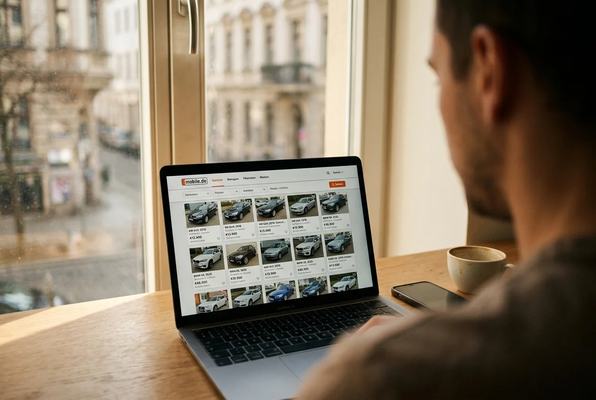
Here's how the full chain works: find a car on mobile.de, AutoScout24, or through our auction service. Pay for it. We register it under our German entity as the Halter (custodian) and insure it the same day. You get German plates. Drive anywhere in the EU, EEA, UK, Turkey, Morocco.

You keep the bill of sale and certificate of ownership. The car is legally yours. We handle the bureaucracy.


Marketplaces

Where to Find Cars in Europe

Five ways to source a car: three public marketplaces, our auction service, and dealer direct for customers blocked by non-resident rules.

  • mobile.de logo

    mobile.de

    Europe's largest marketplace — 1.4M+ listings. Most customers start here. Look for 'HU' (current TUV). Avoid 'for companies or export only' listings — no standard 1-year guarantee.

  • AutoScout24 logo

    AutoScout24

    Covers Germany, Italy, France, Belgium, Netherlands, Austria, and Spain. Good for comparing prices across countries. Multilingual interface.

  • Kleinanzeigen logo

    Kleinanzeigen

    Germany's classified ads platform (formerly eBay Kleinanzeigen). More private sellers, lower prices, less buyer protection. Do more due diligence.

  • CarTurf Auctions logo

    CarTurf Auctions

    We source cars from wholesale auctions across Germany. €750 + 4% of sales price covers bid, fees, shipping, handling. Best for customers who don't want to search.

  • Dealer

    Dealer Direct

    Some dealers refuse non-residents due to franchise territory rules. CarTurf provides the address, handles registration, and the dealer releases the car — Porsche included.

How Remote Car Buying Works

About half of CarTurf's customers buy their car without seeing it in person. They find options on mobile.de, cross-reference the dealer's ratings with Google Maps reviews, and CarTurf handles pickup, registration, and delivery.

Remote buying is normal for us. Here's how customers reduce risk when buying sight unseen:

  • Cross-reference ratings. Check the dealer's mobile.de score against their Google Maps reviews. Consistent ratings = good sign. Divergent ratings = red flag.
  • Ask for a fresh TUV inspection. Costs the dealer about €150. If they refuse, walk away. A fresh inspection is the single best guarantee that the car is mechanically sound.
  • Don't negotiate the price down — negotiate additions up. Listed price on mobile.de is usually final. Ask for winter tires, a fresh inspection, or minor repairs instead.
  • Avoid 'for companies or export only' listings. The dealer isn't required to give private buyers the standard 1-year guarantee. Can also signal underlying issues.
  • Used cars listed with 19% VAT are likely ex-rental or company cars. You'll pay the VAT on top of the listed price.

Once you've bought the car, we pick it up, register it, insure it, and deliver it to Frankfurt, Bratislava, Paris, or wherever you need it.

Sight unseen

Remote

Sight unseen

The Registration Problem for Non-Residents

You can buy a car in any European country. But without residency, you can't register it. No registration means no plates, no insurance, no legal driving. CarTurf registers your car under a German GmbH as the Halter (custodian). You keep the bill of sale and certificate of ownership.

Every EU country requires a local address to register a vehicle. France needs residency. Spain needs an NIE. The Netherlands needs a BSN and Dutch address. There's no tourist registration option anywhere.

Germany has a legal structure that makes an exception possible. The DMV recognises the separation between the Halter (the registered custodian, CarTurf) and the owner (you). Your car gets German plates. Those plates are valid across the entire EU, EEA, UK, and most non-EU countries.

We also offer Italian registration now. It avoids the trip to Germany for TUV inspection, but comes with a trade-off: extended parking with non-Italian plates in Italy can trigger forced re-registration. Most customers choose German registration — clearer legal protections, broader acceptance.

Insurance

Insurance for Non-Resident Car Owners

Four things to understand about getting insured in Europe as a non-resident — from how it activates to how to save money in the off-season.

  • How insurance works with CarTurf

    Insurance is required to complete registration in Germany. Your car is insured the moment it's registered. 10-day paperwork window; rush option 48–72 hours. CarTurf's partner is one of the few that won't decline or deny claims based on residency.

  • Coverage tiers and costs

    Haftpflicht (liability) from €700/yr. Teilkasko (partial) adds fire and theft. Vollkasko (full) adds own-vehicle damage, up to €3,000/yr. Driver protection included. All drivers 23+ with a valid license covered — no need to list names.

  • Why non-resident insurance costs more

    Insurers price in the risk of primary use abroad. A car registered in Germany but driven mostly in Portugal, Turkey, or Morocco carries different risk than one parked in Stuttgart. DIY attempts usually end in rejection or denied claims.

  • Saving money during off-season

    If you're storing the car for a few months, drop coverage to liability or partial — saves money, keeps registration active. Fully secure location? Deregister entirely and stop all payments. Paying annually instead of quarterly saves 10–13%.

Vehicle Types

What Vehicles Can You Buy?

Cars, campervans, luxury and sports, and vans — all registered and insured through CarTurf's German structure.

  • Cars
    Standard

    Cars

    Sedans, hatchbacks, SUVs. Any make, any model. Most customers buy from German dealers through mobile.de. €5,000 used to €100,000+ for luxury.

  • Campervans
    Travel

    Campervans

    About a third of our market. Retirees and long-trip travellers. Conversion covered by the policy. Re-classifying a cargo van as a camper can actually reduce premium. Storage €50/mo.

  • Luxury + Sports
    Premium

    Luxury + Sports

    Porsche, BMW, Mercedes. Some dealers refuse non-residents — CarTurf provides the registration address so the sale closes. Autopilot Premium (€199/mo) for €100K–€500K; Autopilot Lux (€299/mo) up to €1M.

  • Vans
    Utility

    Vans

    Cargo vans for travellers who need space. Same registration process. Can be converted to camper after registration — insurance covers the conversion. Popular with families and pet owners.

Cost

What Does It Actually Cost?

A typical first year through CarTurf: €249 one-time signup, 12 months at €99/month (€1,188), insurance (€700–3,000/year), and tax (€150–300/year). Total fees excluding the car: roughly €2,150–4,550. Compare to 12 months of rental at €1,000+/month (€12,000+) with no ownership.

The full picture for year one:

  • Sign-up fee

    €249

    one-time

  • Service fee

    from €99/mo

    tiered

  • Insurance

    €700–3,000

    / year

  • Vehicle tax

    €150–300

    / year

  • TUV inspection

    €150–350

    every 2 years

Total first year: roughly €2,150–€4,550 plus the car itself. For vehicles valued over €100,000, use Autopilot Premium (€199/mo) for €100K–€500K or Autopilot Lux (€299/mo) up to €1M.

Compare that to a long-term rental. Six months of renting a mid-range car in Europe costs €6,000–9,000. No ownership. Country restrictions. Mileage caps. With CarTurf, you own the car, drive it anywhere, and the monthly cost drops every year as insurance gets cheaper.

Paying insurance quarterly adds about 10–13% to the annual cost. Annual payment is the cheapest option.

Not Sure Yet? See What It Costs

Get the complete pricing for your specific vehicle type, coverage level, and payment schedule.

CarTurf vs. Other Ways to Get a Car in Europe

Comparison based on CarTurf operational data and customer-reported alternatives.

  • CarTurf

    ★ Our pick
    Cost
    €249 + from €99/mo + insurance
    Duration
    Unlimited
    Own the Car?
    Yes
    Country Limits
    None. EU-wide + UK, Turkey, Morocco
    Legal Risk
    None
  • Long-term rental

    Cost
    €1,000–1,500/mo
    Duration
    3–12 months
    Own the Car?
    No
    Country Limits
    Often restricted to specific countries
    Legal Risk
    None
  • Citroen buy-back

    Cost
    €5,000–10,000 for 6 months
    Duration
    Max 6 months
    Own the Car?
    Temporary
    Country Limits
    French cars only
    Legal Risk
    None
  • Bulgarian plates

    Cost
    €650 + annual renewal
    Duration
    1 year
    Own the Car?
    Yes
    Country Limits
    Gray area in Western Europe
    Legal Risk
    High
  • Export plates

    Cost
    €100–300
    Duration
    6–12 months
    Own the Car?
    Yes
    Country Limits
    Germany only, can't renew
    Legal Risk
    Low
  • Friend's name

    Cost
    Free
    Duration
    Unlimited
    Own the Car?
    Legally theirs
    Country Limits
    Their country only
    Legal Risk
    Very high

Country Guides

Buying Guides by Country

Country-by-country notes: where to search, what's required locally, and how CarTurf's structure handles it.

  • Buy a Used Car in Germany flag

    Buy a Used Car in Germany

    The largest market in Europe. Where most CarTurf customers find their car.

    Learn more

  • Buying a Car in Italy flag

    Buying a Car in Italy

    Buy locally and register with Italian plates. No trip to Germany needed.

    Learn more

  • Buying a Car in France flag

    Buying a Car in France

    France requires residency. Buy there and register through CarTurf instead.

    Learn more

  • Buying a Car in Spain flag

    Buying a Car in Spain

    Spain needs NIE + residency. German plates let you buy and drive without either.

    Learn more

  • Buying a Car in Portugal flag

    Buying a Car in Portugal

    Portugal requires a fiscal number. CarTurf's German registration sidesteps it.

    Learn more

  • Buying a Car in the Netherlands flag

    Buying a Car in the Netherlands

    BSN and Dutch address required locally. German plates are the alternative.

    Learn more

  • Buying a Car in Greece flag

    Buying a Car in Greece

    AFM tax number required. Non-residents can't register directly.

    Learn more

  • Buying a Car in Austria flag

    Buying a Car in Austria

    Meldezettel required. Non-residents blocked from local registration.

    Learn more

  • Buying a Car in Switzerland flag

    Buying a Car in Switzerland

    Switzerland isn't EU but German plates work here too.

    Learn more

  • Buy a Car in Norway flag

    Buy a Car in Norway

    High import taxes. Here's what to know about buying and driving in Norway.

    Learn more

More Buying Topics

Deeper reads on vehicle types, how-to guides for buying, research-heavy posts, and guides by nationality and lifestyle.

  • Vehicle Type

    Buy a Campervan in Europe

    About a third of our market. Campervan-specific buying, insurance, and storage.

    Read more

  • How-To

    Mobile.de in English: Buying Guide

    Step-by-step guide to using mobile.de as a foreigner. Filters, red flags, dealer ratings.

    Read more

  • How-To

    German Car Auctions: How to Buy

    How CarTurf brokers auction purchases. Costs, process, and what to expect.

    Read more

  • How-To

    Car Dealers in Germany: Guide for Foreigners

    What to expect from German dealers. Negotiation, guarantees, and red flags.

    Read more

  • Research

    Cheapest Countries to Buy a Car in Europe

    Country-by-country price comparison. Where the deals are and what to watch for.

    Read more

  • Research

    Used Car Market in Europe

    Market overview: prices, trends, and where to look across European countries.

    Read more

  • Research

    How Much Does It Cost to Own a Car in Europe?

    Total cost of ownership: purchase, registration, insurance, tax, maintenance.

    Read more

  • By Nationality

    Buy a Car as an American

    Specific guide for US citizens buying and driving in Europe.

    Read more

  • By Nationality

    Buy a Car as an Australian

    Guide for Australians. Covers right-hand drive, insurance, and the Schengen clock.

    Read more

  • By Nationality

    Buy a Car as a Canadian

    Canadian-specific guide: dollar-based budgeting, insurance, and documentation.

    Read more

  • Lifestyle

    Retiree Motorhome Travel in Europe

    For retirees planning extended motorhome trips. Buying, storing, and insuring.

    Read more

  • Lifestyle

    Family Car for Temporary Relocation

    Relocating to Europe temporarily with family. Vehicle options and logistics.

    Read more

Not Sure Yet? See What It Costs

Get the complete pricing for your specific vehicle type, coverage level, and payment schedule.

FAQ

Buying a Car in Europe — FAQ

Common questions about buying a car in Europe as a non-resident, remote buying, costs, and what happens when you're done.

Yes. Anyone can buy a car in Europe regardless of citizenship. The problem isn't buying. It's registering and insuring the car, because every EU country requires residency. CarTurf registers under a German entity so you get plates and insurance without EU residency.

Germany has the largest used car market and generally the most competitive prices. Eastern European countries (Poland, Czech Republic, Romania) have lower sticker prices, but import fees and registration barriers add cost. Buying in Germany and registering through CarTurf avoids cross-border complications.

Yes. About half of CarTurf's customers buy their car remotely without seeing it in person. Cross-reference the dealer's mobile.de rating with their Google Maps reviews. Ask for a fresh TUV inspection. CarTurf can also source cars from auctions on your behalf.

Three options. Keep the registration active and store the car (€50/mo near our office, we start the engine periodically). Sell it through CarTurf's selling service (€500 plus 1% of sales price). Or deregister and register in another country, which stops all CarTurf payments.

No. CarTurf accepts Wise (instant), Revolut (few hours), debit cards, credit cards, and cryptocurrency via our Dubai entity. Insurance and tax can be paid quarterly, semi-annually, or annually. No European bank account required.